The Tractatus Logico-Philosophicus (TLP) (Latin for Logico-Philosophical Treatise) is the only book-length philosophical work published by the Austrian philosopher Ludwig Wittgenstein in his lifetime. The project had a broad aim - to identify the relationship between language and reality and to define the limits of science 1] - and is recognized as a significant philosophical work of the twentieth century. G. E. Moore originally suggested the work's Latin title as homage to the Tractatus Theologico-Politicus by Baruch Spinoza. 2] Wittgenstein wrote the notes for the Tractatus while he was a soldier during World War I and completed it during a military leave in the summer of 1918. 3] It was first published in German in 1921 as Logisch-Philosophische Abhandlung. The Tractatus was influential chiefly amongst the logical positivists of the Vienna Circle, such as Rudolf Carnap and Friedrich Waismann. Bertrand Russell's article The Philosophy of Logical Atomism is presented as a working out of ideas that he had learned from Wittgenstein. The Tractatus employs a notoriously austere and succinct literary style. The work contains almost no arguments as such, but rather consists of declarative statements, or passages, that are meant to be self-evident. The statements are hierarchically numbered, with seven basic propositions at the primary level (numbered 1-7), with each sub-level being a comment on or elaboration of the statement at the next higher level (e.g., 1, 1.1, 1.11, 1.12, 1.13). In all, the Tractatus comprises 526 numbered statements, with 1, 2, 3, 4, 5, 6 and 7 having 7, 79, 74, 109, 151, 105 and 1 associated statement(s), respectively. Wittgenstein's later works, notably the posthumously published Philosophical Investigations, criticised many of the ideas in the Tractatus. Wittgenstein concluded that the Tractatus had resolved all philosophical problems. The book was translated into English by C. K. Ogden with help from the teenaged Cambridge mathematician and philosopher Frank P. Ramsey. Ramsey later visited Wittgenstein in Austria. Translation issues make the concepts hard to pinpoint, especially given Wittgenstein's usage of terms and difficulty in translating ideas into words. 25] The Tractatus caught the attention of the philosophers of the Vienna Circle (1921-1933), especially Rudolf Carnap and Moritz Schlick. The group spent many months working through the text out loud, line by line. Schlick eventually convinced Wittgenstein to meet with
Ludwig Wittgenstein's influential Tractatus Logico-Philosophicus explores the assumption that it is philosophy's task to 'sanitize' language. Therefore, it is necessary for philosophy to develop an artificial language that avoids the pitfalls of ordinary language. This is the only philosophical work
The first comprehensive anthology of the major works of the greatest philosopher of the 20th century ( New York Times Book Review ) Austrian philosopher Ludwig Josef Johann Wittgenstein contributed several groundbreaking ideas to philosophy, primarily in the foundations of logic, the philosophy of m
'what can be said at all can be said clearly; and of what one cannot talk, about that one must be silent' Wittgenstein's Tractatus Logico-Philosophicus , first published in German in 1921 and in English translation in 1922, is one of the most influential philosophical texts of the twentieth century.
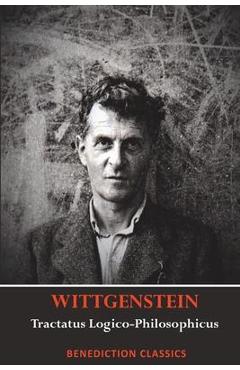
First published originally in German in 1921, Tractatus Logico-Philosophicus is the only book-length philosophical work by Austrian philosopher Ludwig Wittgenstein published during his lifetime. Based upon notes made during his time serving in World War I, the treatise is composed of 526 numbered de