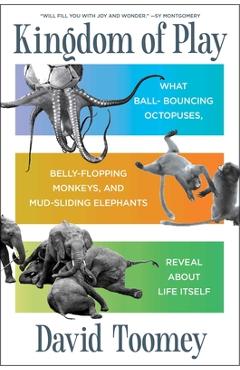
For readers of Inside of a Dog and The Soul of an Octopus, a fascinating, charming, and revelatory look at the science behind why animals play that shows how life--at its most fundamental level--is playful. In Kingdom of Play, critically acclaimed science writer David Toomey takes us on a fast-paced and entertaining tour of playful animals and the scientists who study them. From octopuses on Australia's Great Barrier Reef to meerkats in the Kalahari Desert to brown bears on Alaska's Aleutian Islands, we follow adventurous researchers as they design and conduct experiments seeking answers to new, intriguing questions: When did play first appear in animals? How does play develop the brain, and how did it evolve? Are the songs and aerial acrobatics of birds the beginning of avian culture? Is fairness in dog play the foundation of canine ethics? And does play direct and possibly accelerate evolution? Monkeys belly-flop, dolphins tail-walk, elephants mud-slide, crows dive-bomb, and octopuses bounce balls. These activities are various, but all are play, and as Toomey explains, animal play can be seen as a distinct behavior--one that is ongoing and open-ended, purposeless and provisional--rather like natural selection. Through a close examination of both natural selection and play, Toomey argues that life itself is fundamentally playful. A globe-spanning journey and a scientific detective story filled with lively animal anecdotes, Kingdom of Play is an illuminating--and yes, playful--look at a little-known aspect of the animal kingdom. This delightful...compelling (Scientific American) and revelatory look at the science behind why animals play will fill you with joy and wonder (Sy Montgomery, author of The Soul of an Octopus). Acclaimed science writer David Toomey takes us on a fast-paced and entertaining tour of playful animals and the scientists who study them. From octopuses on Australia's Great Barrier Reef to meerkats in the Kalahari Desert to brown bears on Alaska's Aleutian Islands, we follow adventurous researchers as they design and conduct experiments seeking answers to new, intriguing questions: When did play first appear in animals? How does play develop the brain, and how did it evolve? Are the songs and aerial acrobatics of birds the beginning of avian culture? Is fairness in dog play the foundation of canine ethics? And does play direct and possibly accelerate evolution? Monkeys belly flop, dolphins tail-walk, elephants mud-slide, crows dive
This is a work of practical theology and cultural philosophy, demonstrating the religious nature of all human actions and institutions. In The Mission of God , Joe Boot examines the historic biblical perspective on everyday cultural matters, demonstrating the abiding validity and authority of the wh
hrough the story of an ordinary man unwittingly drawn into a senseless murder on an Algerian beach, Camus explored what he termed the nakedness of man faced with the absurd. First published in English in 1946; now in a new translation by Matthew Ward. opsis 2: The Stranger is the enigmatic first nov
The Must-Have Guide for Every Young Axolotl Owner. Your aquatic adventure awaits! Axolotls are not just any ordinary pet. They have the power of regeneration, play a crucial role in medical research, and have a captivating life cycle. But how do you care for such a special creature? What do they eat
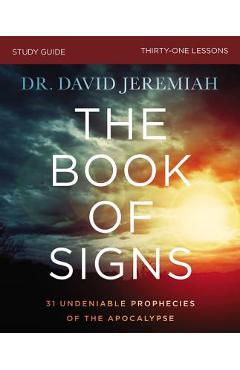
What are the signs that the end times are near?Do you find yourself disheartened when you hear the news events of the day? Wars raging across the world. Crisis after crisis occurring in the homeland. Moral decay seemingly celebrated in the media outlets. Just when it seems things can't get any worse