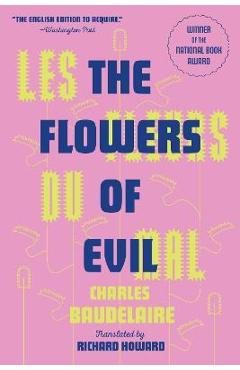
Known to his contemporaries primarily as an art critic, but ambitious to secure a more lasting literary legacy, Charles Baudelaire, a Parisian bohemian, spent much of the 1840s composing gritty, often perverse, poems that expressed his disgust with the banality of modern city life. First published in 1857, the book that collected these poems together, Les Fleurs du mal , was an instant sensation--earning Baudelaire plaudits and, simultaneously, disrepute. Only a year after Gustave Flaubert had endured his own public trial for published indecency (for Madame Bovary ), a French court declared Les Fleurs du mal an offense against public morals and six poems within it were immediately suppressed (a ruling that would not be reversed until 1949, nearly a century after Baudelaire's untimely death). Subsequent editions expanded on the original, including new poems that have since been recognized as Baudelaire's masterpieces, producing a body of work that stands as the most consequential, controversial, and influential book of poetry from the nineteenth century. Acclaimed translator and poet Aaron Poochigian tackles this revolutionary text with an ear attuned to Baudelaire's lyrical innovations--rendering them in an assertive blend of full and slant rhymes and fluent iambs (A. E. Stallings)--and an intuitive feel for the work's dark and brooding mood. Poochigian's version captures the incantatory, almost magical, effect of the original--reanimating for today's reader Baudelaire's unfailing vision that trumpeted the space and light of the future (Patti Smith). An introduction by Dana Gioia offers a probing reassessment of the supreme artistry of Baudelaire's masterpiece, and an afterword by Daniel Handler explores its continued relevance and appeal. Featuring the poems in English and French, this deluxe dual-language edition allows readers to commune both with the original poems and with these electric, revelatory translations.
Upon its original publication in 1857 Charles Baudelaire's Les Fleurs du Mal or The Flowers of Evil was embroiled in controversy. Within a month of its publication the French authorities brought an action against the author and the book's publisher claiming that the work was an insult to public dece
Howard, Richard: - Richard Howard was one of the most prolific and respected twentieth-century literary critics and translators. He won a Pulitzer Prize, a PEN Translation Prize, a National Book Award (for Les Fleurs Du Mal (The Flowers of Evil) ), a Literary Award from the Academy of Arts and Lette