During his life, Geoffrey Chaucer (born c.1340) was courtier, diplomat, revenue collector, administrator, negotiator, overseer of building projects, landowner and knight of the shire. He was servant, retainer, husband, friend and father. Whilst he was doing and ‘being’ all of these things, he was writing. Not only did he write in English - for princes, friends, family and, presumably, for his own pleasure – but his knowledge of French and Italian enabled him to engage with the works of notable French poets such as Eustache Deschamps, and also with the Italian works of Petrarch, Dante and Boccaccio, an understanding which he used to enrich and develop his own language.It was Boccaccio's Decameron which inspired Chaucer, in the 1390s, to begin work on The Canterbury Tales, which was still unfinished at his death in October 1400. It tells the story of a group of 30 pilgrims who meet at the Tabard Inn in Southwark, on the south bank of the Thames opposite the city of London, and travel together to visit the then famous shrine of St Thomas Becket in Canterbury cathedral. The tavern host, who accompanies them, suggests that they amuse one another along the way by telling stories. There will be a prize for this: the best storyteller will get a free meal in the tavern on their return. The stories told by the pilgrims range from bawdy comedies through saints' lives and moral tracts to courtly romances, but are always delivered with a generous helping of Chaucer's own sly wit and ironic humour. Although based on the stereotypes of ‘estates satire’, his pilgrims appear as individuals who can be recognised by their audience. Chaucer succeeds in his aim of producing an overview of his times and their culture, for posterity, in the manner of Italian, proto-Renaissance, writers. In the decades after his death, Chaucer was recognised and elevated by a new generation of writers to a position of prominence in the emerging canon of English writing, from which he ultimately became known as ‘the Father of English Literature’.This transcription and edition is taken from British Library MS Harley 7334, produced within ten years of Chaucer's death. The aim of this edition, with on-page notes and glosses, is to enable readers with little or no previous experience of Medieval English to read and enjoy this landmark in English Literature.
The procession that crosses Chaucer's pages is as full of life and as richly textured as a medieval tapestry. The Knight, the Miller, the Friar, the Squire, the Prioress, the Wife of Bath, and others who make up the cast of characters -- including Chaucer himself -- are real people, with human emoti
Assembling at the Tabard Inn in Southwark, a group of pilgrims begin their journey to Canterbury Cathedral. To entertain themselves on the long road, their host suggests that they regale each other with stories, with the teller of the best tale set to earn a free supper.The pilgrims correspond to al
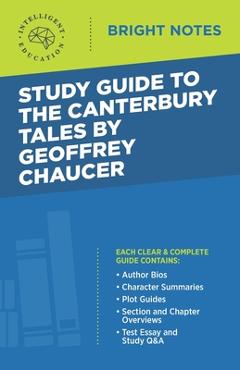
A comprehensive study guide offering in-depth explanation, essay, and test prep for Geoffrey Chaucer's The Canterbury Tales, arguably the most famous of all Middle English literature. As a series of twenty-four stories, The Canterbury Tales was written in 1392 and tells of the pilgrimage of thirty p